How to Prepare Kids for Math Olympiad (Without Making Maths Feel Stressful)
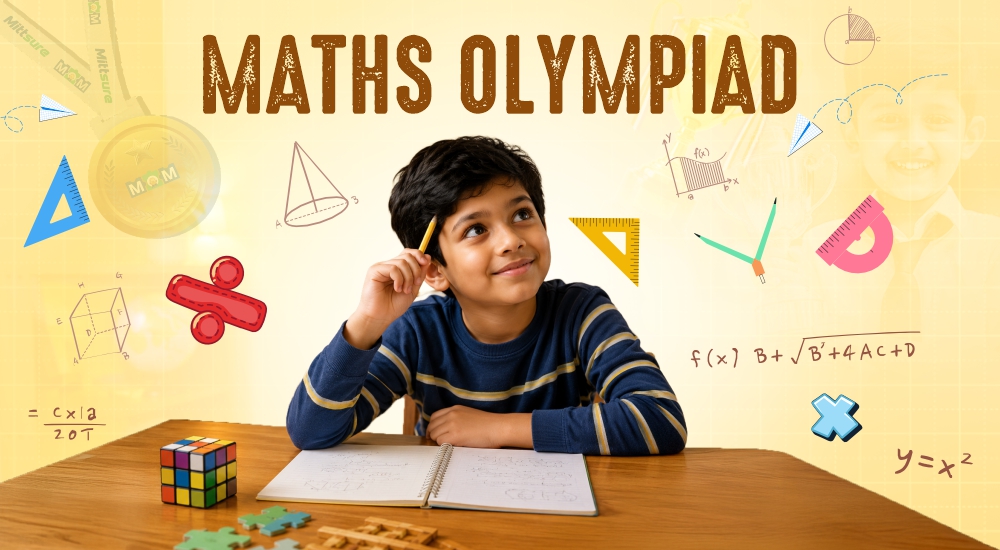
There are more than 100+ countries that participate in Maths Olympiad annually. It has somewhere become a global movement that nurtures talent in mathematics, builds passion in problem-solving, and creates new next-generation thinkers for the future. And do you know where it all started?
In the 1840s!
When official maths contests were discovered in imperial Russia, the event was called “first city-level olympiads”. It was discussed to be organised for high school students and more insights on the educational and social aspects of the high school educational system of that time was put forward.
Then in 1894, the earliest organized contest was held and it became the first ever organized math competition.
Fast forward to today, Maths Olympiads has become one of the most prestigious Olympiad with more than 110+ countries, 630+ IMO participants, 600,000+ annual participants worldwide.
When students attempt Math Olympiads, they develop non-routine problem solving skills that help them tackle unpredictable issues, new & unexpected circumstances that they might have never come across.
It also reduces cognitive load as it frees up the brain's mental workspace that holds a small amount of information in an active state with which a person is able to process information, manipulate decisions, and reason with different situations altogether.
So the importance of olympiad exam becomes clear that the Math Olympiad is important and students must sit for it. But before sitting, what are the preparations that have to be done is what this blog is about! Consider this as the ultimate guide to prepare kids for the Math Olympiad.
What are the 5 Best Ways to prepare kids for Maths Olympiads?
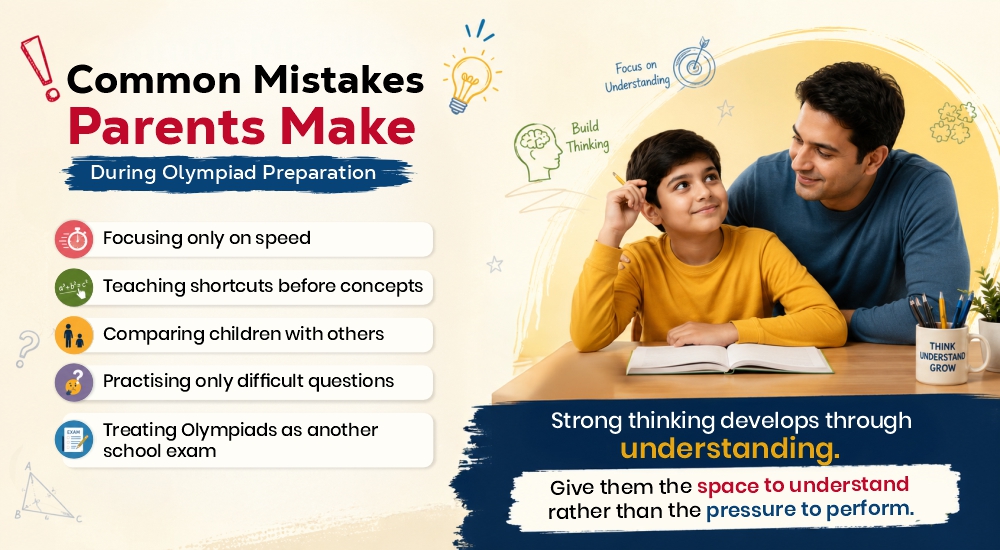
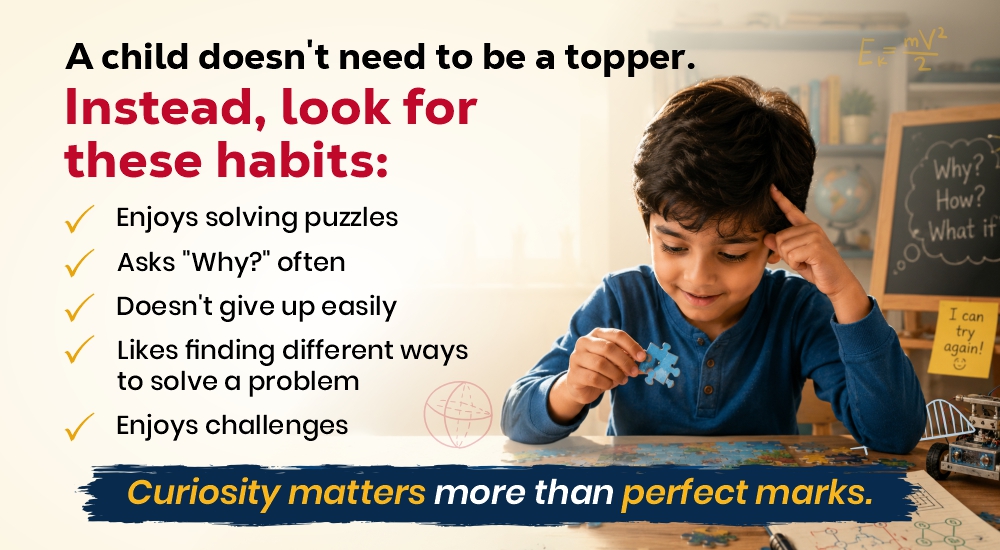
Gone are the days where only “extra smart students” naturally brilliant at calculations were considered fit to participate. Today, Olympiad preparation has become an early thinking habit that every kid can take part in as it helps improve logic, confidence, and structured problem solving right from the age when they sit for their first exam. So here are a few key points to not to help kids prepare better for Math Olympiads.
Build Strong Conceptual Understanding First
When a child studies on their own, they remember the formula as Perimeter = (Length+Breadth)
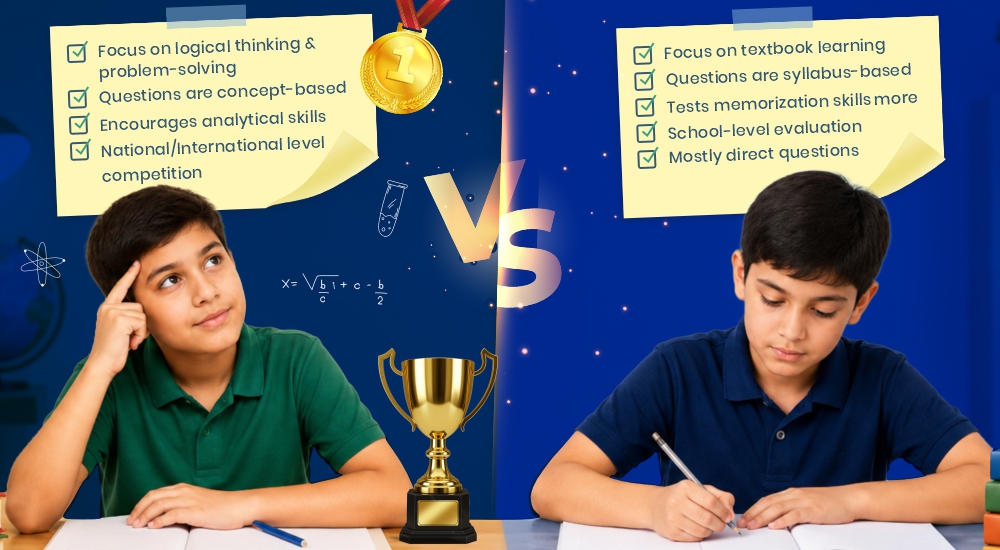
After the CBSE rolled out, schools have also started focusing on competency based education and questions asked in schools exams to check whether kids have understood the concept of perimeter would be something like:
A rectangular playground is 15 meters long and 10 meters wide. Find the total distance covered by a boy who runs around it once.
And then comes Olympiads. When students sit for Math Olympiad exams the same concept has a question drafted like:
A rectangular wire frame has a length of 18 cm and a width of 12 cm. A child unwires it and reshapes it into a perfect square. What is the length of each side of this new square?
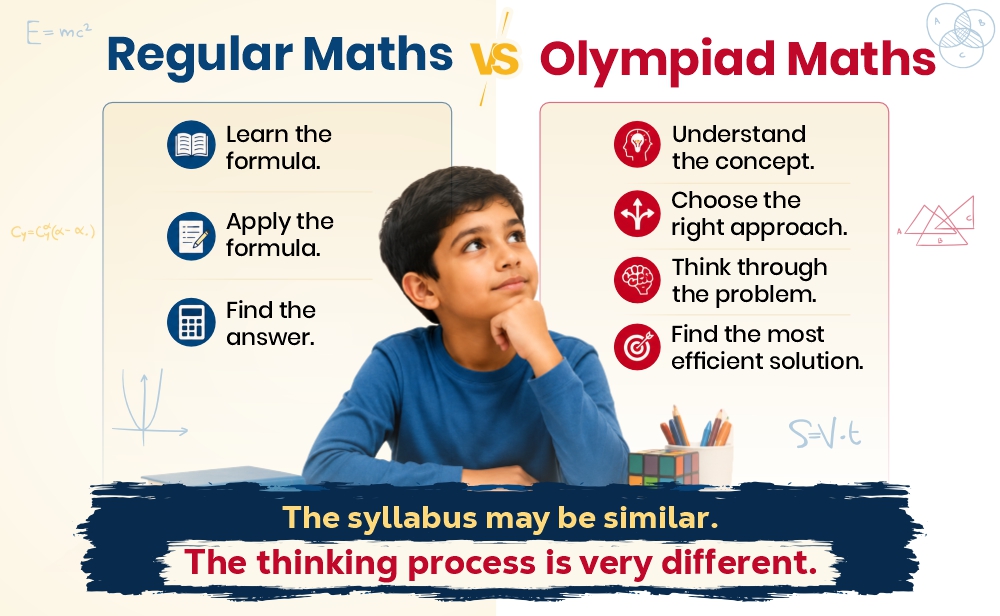
The difference in all three is that when kids learn they simply remember the formulas. In schools they are asked questions in a way that they learn how to apply their knowledge to these questions. And then there’s Olympiad exams that bring together different concepts and understanding for children to think broader and sharper.
Make Children Comfortable With Thinking-Based Questions
Most of us have been learning tables. Some up to 10, up to 20, or maybe up to 30. This way memorization helps like “twenty four fives are one hundred and twenty”. But if learners do not know how to apply it in real life, all their memory goes to waste.
So teaching kids to think is also a thing to look into. Where they not only come across concepts but also know where to apply it.
So if given a question “A shop packs chocolates equally into 5 boxes. If there are 24 chocolates in each box, how many chocolates are packed altogether?”
Give them puzzle-based maths, logical questions, toys that help them recognise patterns better, multi step problems, olympiad study materials that makes them think more and beyond.
Initially they might find it difficult, or mugging up tables might look easier, but in the longer run they would be able to solve unfamiliar situations more mindfully.
Improve their mental maths and calculation speed
Participating in Maths Olympiads does not just mean that children have to sharpen their intelligence. It also means that they need to shape their speed and accuracy skills. Because if they sit for exams with basic calculation power, it may take too much time and children might not be able to focus better on actual reasoning then.
So help them master core maths facts like learning tables, squares, cubes, fraction-decimal conversions. This will help them in calculating mid-step numbers, instantly recognise the calculations, and might help in skipping the time taken in multiplying or dividing.
Help them in learning mental math tricks like breaking big numbers intro friendly parts like 57*5 can be broken down into [(50*5)+(7*5) = 285]. Teach them how to round numbers up or down to calculate faster like (98 + 45) becomes (100 + 45 - 2 = 143) and also how to double the number and halve the other like (14 times 5) becomes (7 times 10 = 70).
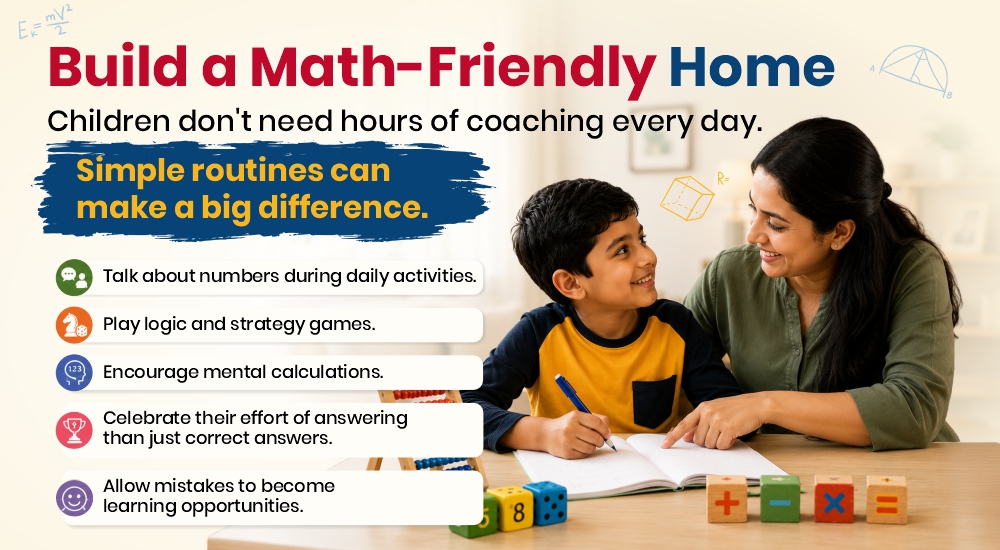
Focus on their daily habits like for all small calculations do they use calculators or know how to calculate it mentally. And try to keep them consistent even if it is a short daily practice as shorter daily practice builds neural pathways faster than occasional long sessions.
Introduce Time-Based Practice Slowly
There are so many times children hear from their parents talking to others that kids have knowledge and are quite bright yet do not study so marks are less. Similar is the nature of kids knowing the concepts, how to apply them, and figure out the answers, but do not know how to manage their time well. They end up staying bothered and sometimes not able to complete their paper on time leading to nervousness and underconfidence that they are not that smart.
So timed practice should be introduced on time. You can do it gradually, starting from a short span, instead of aggressively habituating them to the timings required in Maths Olympiads. Some simple ways to do it are by starting with small question sets, short reasoning activities, times puzzle solving, and fun mental maths challenges. And once they become comfortable, start increasing the complexity slowly.
This will eventually help them to stay calm under pressure, improve their speed without compromising on their confidence, learn to select questions wisely while estimating how much time is going to take, and overall build clarity during exams.
Create an environment where learning feels engaging
If you force them to sit and study, or make things motivational for them but it is not of any purpose or interest, it will remain boring to them. The intent of studying will never be clear to them and they might end up just rote learning the concepts. Instead, if they actively participate they’ll learn their best. And it can be done by introducing them to activity based games, thinking-based worksheets, logic based activities, competitive exposure to early grades.
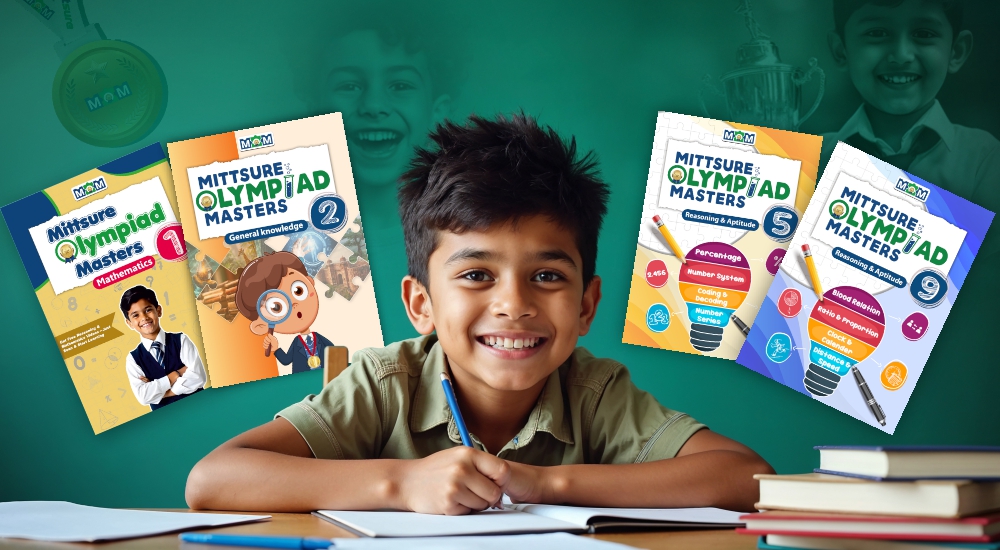
And this is possible with Mittsure Olympiad Masters, where students get an early edge to sit for Math Olympiad right from when they are in Class 1. Olympiad exams are not just about ranks, marks, medals, or comparison, it is about building real value and skills in children so that they are able to think better, be disciplined, stay patient, boost confidence, and sharpen their academic skills too.
Because the students who learn how to think today are the ones who adapt better tomorrow.
FAQs
1. Why should children start preparing for Math Olympiads early?
When children start preparing for Math Olympiads early it helps them build logical thinking, confidence, and sharpens their problem solving skills that eventually helps them lessen their pressure when sitting for competitive exams.
2. Are Math Olympiads only for academically strong students?
No no… Not at all. Any child who is curious, can practice consistently and open to new ways of thinking can sit for Math Olympiads. The eligibility is not to be a topper but to be curious.
3. What kind of questions are asked in Math Olympiads?
Questions that make kids think logically, how to apply concepts in real situations, focus on understanding the different patterns that are there, and accordingly questions that test how students are thinking rather than what they have memorized are asked in Math Olympiads.
Recent Posts


- Mittsure Olympiad

- Mittsure Olympiad

- Mittsure Olympiad
- Mittsure Olympiad

- Mittsure Olympaid
- Mittsure Olympiad

- Mittsure Olympiad




- Mittsure Olympiad