What is Structured Thinking and How Does It Help in Olympiad Exams?
What comes first - the answer or the way children think about the problem?
Two children look at a difficult question.
There are patterns, numbers, clues, and several other answers in front of them. One of the children immediately starts choosing an option for an answer. And the other child stops, looks carefully, and breaks the question into parts, then starts solving it.
What creates this difference?
Most of the time, it is not simply about how much the child knows; it is about how they organise what they know. The real challenge for children can be figuring out which information to use and how to use it effectively.
This is where Structured Thinking comes in.
Structured Thinking is about helping children to organise their thoughts before concluding. This is a broader approach than immediately looking for an answer, as children learn to pause, understand the problem, identify what they need, break it into smaller parts, look for connections, and then decide how to approach it.
The idea of developing thinking as a deliberate skill has also been explored by Edward de Bono- he’s a Maltese physician and author best known for originating the term “lateral thinking,” that has been described as structured creative thinking. He is one of the most cited figures in this space and pioneered teaching thinking as a deliberate skill in businesses and schools.
So, what does Structured Thinking look like in a child?
It can be as simple as a child stopping before answering a question and asking:
What do I know?
What is the question asking?
Which information is useful?
What should I do first?
Does my answer make sense?
These questions seem simple, but they encourage children to slow down, organise their thoughts and make decisions based on reasoning rather than immediately guessing.
This way of thinking becomes effectively useful when children encounter questions where the answer is not immediately obvious. And this is exactly where it connects with Olympiad-style problem-solving.
How can Structured Thinking Make Olympiad Problem-Solving Easier?
Olympiad questions often present children with problems that involve more than recall of formulas, definitions, or facts. These questions require recognising patterns, connecting different pieces of information, deciding which approach is suitable, or comparing possibilities. Structured thinking provides children with a systematic way to work through all these questions.
Instead of immediately jumping to or searching for an answer, children can learn to follow a simple sequence that helps them understand the question, identify the information, solve step by step, find the relationship, and review the answer. Hence, this approach brings clarity to problems that initially appear complicated.
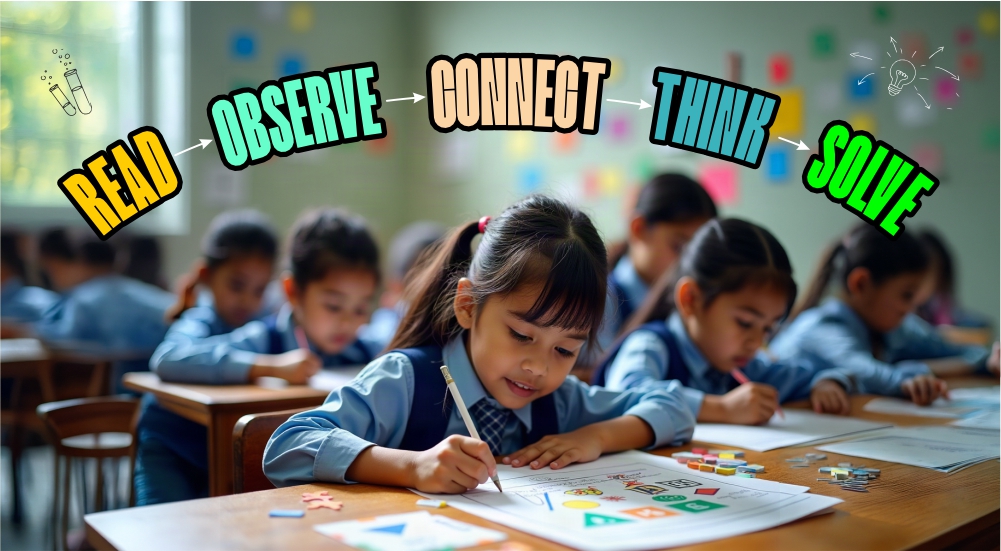
For example, there is a sequential question: What comes after the sequence 3, 6, 12, 24?
A child can quickly select an option by guessing what comes next. However, structured thinking helps in encouraging the child to examine the relationship between different numbers. Every number is twice the previous one that helps the child to identify the pattern and arrive at 48 with a clear reason.
The same thinking process is applied to mathematical problems, reasoning questions, classification activities, and different pattern-based challenges. When a question involves several details, children can also learn to differentiate relevant information that does not contribute to the solution.

This is what makes structured thinking highly valuable in Olympiad preparation. This shifts the focus from simply asking “What is the answer?” to asking “How can I formulate the answer?” Over time, this approach helps in encouraging children to solve problems with a high level of clarity, logic, and purpose rather than simply relying on quick guesses.
How Does Structured Thinking Work When Solving an Olympiad Question?
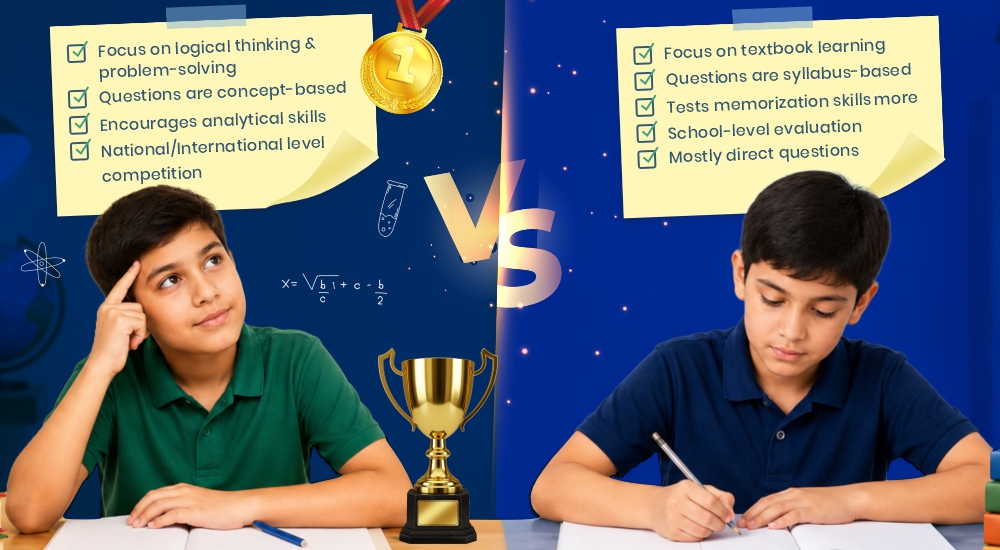
Olympiad exams differ from regular classroom exams in the way they encourage children to approach questions. Regular exams mainly assess how well students remember and understand concepts that are taught in class. However, Olympiad exams require young learners to identify relationships, apply concepts, analyse information, and find logical solutions.
When a question looks unfamiliar, Structured Thinking encourages the child to examine the information and understand what is being asked and work out how to proceed instead of immediately relying on a memorised method.
For example, in a Mathematical Olympiad, there is a combination of numbers with a condition or pattern. Firstly, the child needs to understand what the question is asking, identify useful information, and decide which concepts or methods that can be applied. Hence, this kind of approach also aligns with STEM-oriented learning where children are encouraged to identify relationships, analyse information, apply concepts, and work towards logical solutions.
As a result, Structured Thinking helps in developing habits such as reasoning, observation, application, analysis, and problem-solving. All these skills are highly useful not only for answering Olympiad questions but also for approaching unfamiliar problems with greater confidence.
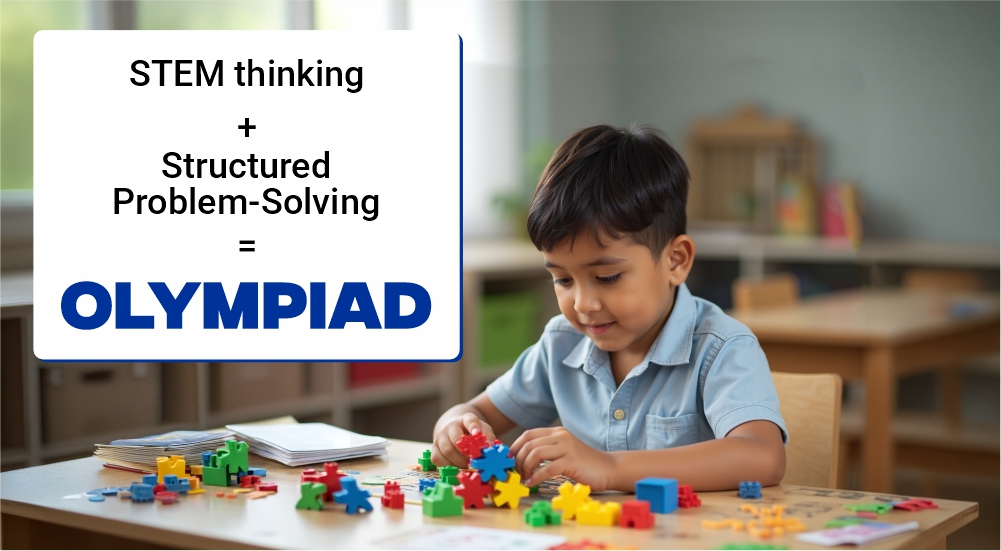
Ultimately, Olympiad preparation helps provide children with a ample opportunities to practice how to think when the answer is not immediately obvious, as it includes skills that can continue to support learning beyond the regular examination.
How can Parents Encourage Structured Thinking?
Everyday activities become a starting point for structured thinking when children are encouraged to observe, pause, ask questions, and explain their thinking. It can develop through small moments where parents involve clear discussion in explaining thinking and observations.
So, the real question is: how can parents bring this way of thinking into a child’s everyday learning?
One simple approach is to ask children to explain their thinking instead of focusing only on the final answer.
In the Olympiad question, there are four different figures, and the child is asked to identify the one that does not belong to the group. A child immediately points to one figure. Instead of confirming whether the choice is correct, a parent asks:
“What did you notice first?”
At this time, the child starts comparing the figures and identifying common features among them. Hence, the parent can then take the conversation a little further by adding:
“What do the other three figures have in common?”
This question encourages the child to look at all the options instead of making a decision that is based on one observation. In this, the next question could be:
“Does this same rule work for all these four figures?”
Now the child can analyse the observation and see whether the selected answer fits the question. And if the child reaches the wrong conclusion, the parent can avoid immediate correction and instead ask:
“What else could we check?”
This approach can give the child an opportunity to revisit information, consider another possibility, and redefine the approach:
“Sometimes, the best way to teach children how to think is to give them one more question instead of one more answer.” In the broader sense, Structured Thinking is not about finding an answer quickly. It is about helping children to understand how they arrive at an answer, what information they need, and which steps can help them to solve a problem. For a child preparing for an Olympiad exam, this can help them to approach unfamiliar questions with greater clarity, think through different possibilities, and apply their knowledge more purposefully. Over time, these habits can become a part of how children approach challenges, both within academics and beyond the examination.
Recent Posts



- Mittsure Olympiad

- Mittsure Olympiad


- Mittsure Olympiad

- Mittsure Olympiad


- Mittsure Olympaid

- Mittsure Olympiad

- Mittsure Olympiad




- Mittsure Olympiad