
What are the Key Differences Between Olympiad Exams vs Regular Exams?
“CBSE allows Class 10 students participating in sports or Olympiads to appear for May 2026 board exams if February exams clash with their events. Schools must submit participant lists by September 30, 2025, for official approval.” mentioned in the Free Press Journal.
This was rolled out by CBSE around September, 2025, signifying that Class 10 board exams now formally recognise Olympiad participation that it has to be a part of a student’s core academic activity profile and not just some side activity that can be planned and put forward.
Currently on social media and ed-influencer reels, there are debates around why kids are crying and parents panicking in Olympiad exams, when they are optional.
Which brings us to a big discussion on how Olympiad exams are different from the regular exams, what parents and schools need to know, and how students need to approach them. This is one of the must-read articles if you wish to understand what Olympiad exams are and how they are different from the regular exams.
Regular Exams and What Do They Build
Every assessment taken by the school to check whether students have understood the concepts taught and the syllabus has been completed can be categorised under the regular exams. Mostly these exams are structured on the basis of the curriculum, evaluated as per the syllabus, to check whether students can reproduce the knowledge that they have learnt in the class.
Mostly it includes unit tests, term exams, and board exams, and how much marks they score decides whether students will be promoted, how will they be graded, and are they eligible to shift to higher classes.
Here is a detailed understanding of what every exam includes and what “regular exams” in actual are:
Classroom/Unit Tests
These are mostly short tests that are taken by the respective teachers after they have completed a chapter or topic. These exams are mostly around 10-20 marks and are conducted for an immediate understanding whether children have understood the few concepts that have been taught.
Term/Semester Exams
Mostly all schools follow an annual or a semester exam pattern and there are some who follow a trimester exam pattern too. Annual pattern is where the assessment is structured at the end of the entire academic year. In semester exams the academic year is divided into two equal terms.
Board Exams (Class 10 & 12)
These are external exams conducted by CBSE, CISCE, and state boards, giving students a structured experience of attempting papers outside of school.
Children will have to attempt all these exams as they are the legal requirements if they wish to apply to colleges, competitive exams (JEE, NEET, CUET, etc) or any scholarship-based schemes.
They generally test the knowledge and the skill of recalling in students as it asks standard definitions, any facts, formulas, and other concepts which are directly asked from the textbook itself. All regular tests together ensure that children remember what they learnt.
By repeatedly giving exams they get used to the revision cycles, they get to understand how to manage time, and prepare a routined system, which ultimately shapes their long-term study discipline.

Olympiad Exams and What Do They Build
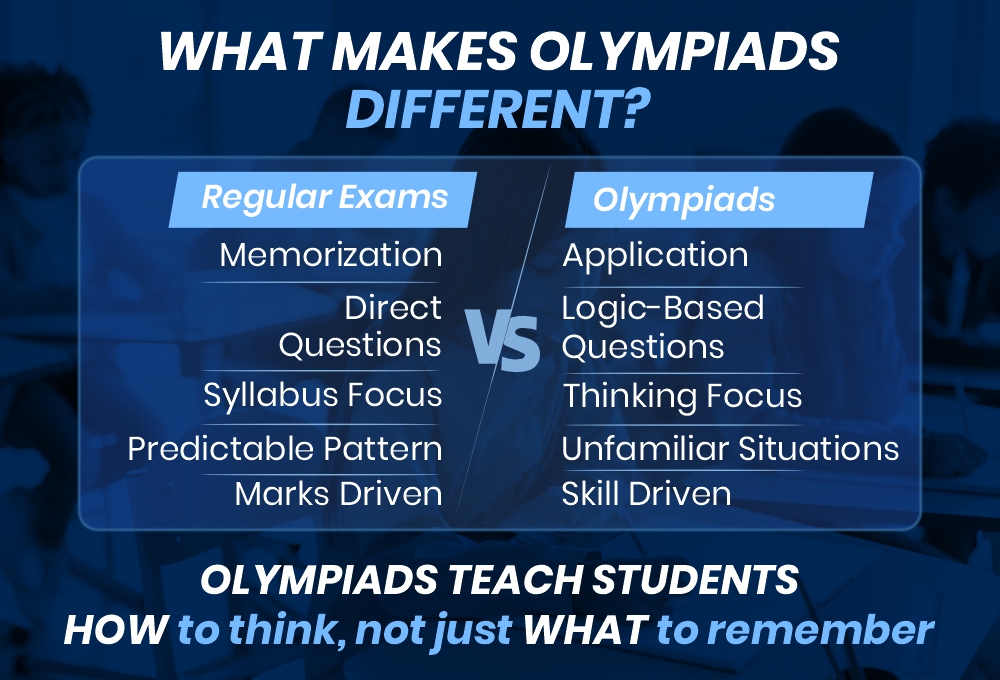
The competitive, concept-deepening tests, that are designed to identify and stretch learners who have higher potential. They test students on the same concepts that they studied, same theories, same facts, same formulas, but in a different way.
It doesn’t just check whether they know the facts, remember the formula, or study the definition, but will they be able to use their knowledge better.
The set of questions in Olympiad exams assess in a way whether they know how their knowledge will have to be used. Are students able to apply those definitions, facts, formulas, etc.
Especially the gap students face once they shift from schools to competitive exams is what the Olympiad exam fulfills.
Initially what would happen was students preparing for the regular exams throughout their schooling. And suddenly when appearing for JEE, NEET, CLAT, CAT, and other competitive exams, they find solving the questions quite difficult.
Because all their school life they had been learning all the theories and other concepts that were necessary. And suddenly after all the years of studying in the same pattern, when they start preparing for competitive exams they realise that they do not know how to apply their knowledge to find out the right answer.
This leads to a lot of students losing confidence, giving up, thinking that it is impossible.
In the limited time of focusing on more knowledge they have to also practice how to apply those knowledge on paper.
This BIG gap can be bridged if they start early.
If they know early that they do not just have to know but also apply them in real life, they will be able to be better in everything they do.
How Olympiads Help Students Prepare for the Future
And that is what Mittsure Olympiad Masters aims to achieve. To bridge this gap from an early age.
Olympiads start from as early as Grade 1 and continue up to Grade 12.
And what started as Maths and Science Olympiads now also have Aptitude & Reasoning, GK & IQ, English, Science, and Maths Olympiads.
All these are subjects that are relevant for the competitive exams.
And when students sit to attempt these papers every year right from when they started in Grade 1, they enhance their thinking capacity, understand how to manage time under pressure, assess questions as per the theories, definitions, facts, formulas etc, and accordingly gain confidence.
So when they sit for their first competitive exam, they are already habituated and do not get nervous seeing the pressure.
Think of it! A child competing at school level, district level, state level, and national level, every year. EVERY YEAR!!
What massive amount of confidence they would be holding.
That is the power of MITTSURE OLYMPIAD MASTERS!
Frequently Asked Questions (FAQs)
1. Are Olympiads harder than school exams?
No, there’s no comparison between Olympiads and school exams, just the way you look at the same concepts becomes different. Olympiad exams are more application and logic based as compared to the regular school exams.
2. Do Olympiads help improve academics?
Absolutely! If children attempt Olympiad exams every year, they study the same concepts and just learn how to apply it if there’s a real life scenario. So it ultimately improves their overall academic performance.
3. Why do Olympiad questions feel different?
Because if a child learns that 9*5 = 45, regular exams will ask what is 9*5, but Olympiad would rather ask the question for the same concept as “A shopkeeper packs pencils in groups of 9. If 5 students each need one group, how many pencils are required altogether?”
4. At what age should students start Olympiads?
Students can begin as early as primary classes because early exposure helps build confidence and thinking skills gradually.
5. What do students actually gain from Olympiad preparation?
Apart from academics, students often develop confidence, problem-solving ability, focus, and stronger thinking skills.
Recent Posts



- Mittsure Olympiad

- Mittsure Olympiad

- Mittsure Olympiad

- Mittsure Olympiad


- Mittsure Olympaid

- Mittsure Olympiad

- Mittsure Olympiad




- Mittsure Olympiad