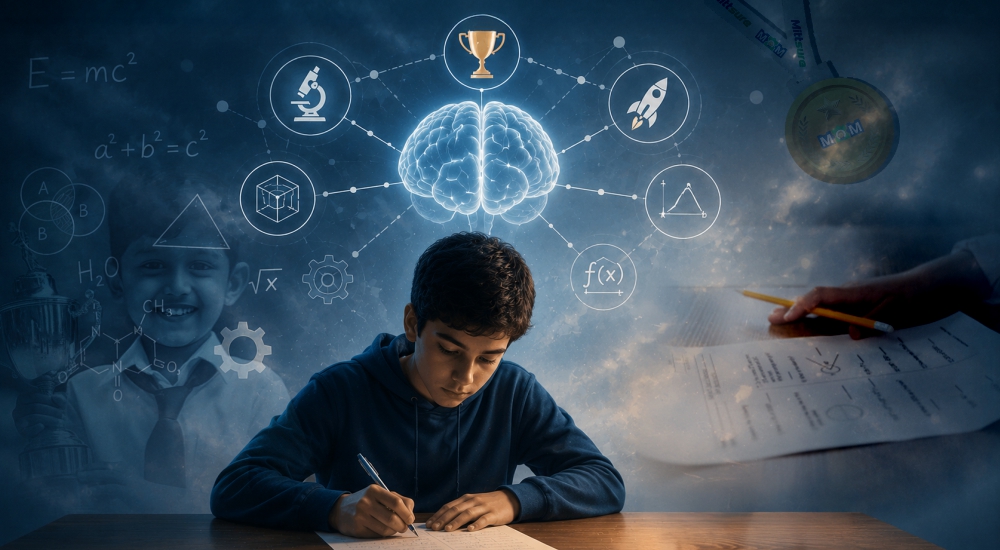
How Olympiads Build STEM Thinking in Students Long Before They Choose a Career
Every year, millions of students study different grades for a better understanding of all the different subjects. They top the half yearly, final, or semester exams also, but there’s a gap that they only realise once they see the bigger picture.
When they sit to prepare for competitive exams, take up some fun coding challenges, work on research projects, or perform tasks that require innovative ideas, it doesn’t look normal. Things become difficult, some students find it hard to understand the new concepts, the topics, etc. And if you ask why?
The reason is simple.
The gap that we mentioned is what they face at the time when exams become different. All this time students have been assessed on the basis of school curriculum and mostly evaluated to check whether they know the concept or not. But competitive exams evaluate them to check whether they are able to apply the concepts in real life too.
And this gap, if filled early, can change the way students see learning from a young age itself. The best way to do it is by introducing Olympiads early. When students participate in Olympiad exams, they get to reason out the questions analytically, think curiously of all the solutions, experiment with different theories, observe deeply, enhancing their problem solving ability too.
And all this builds a strong foundation of STEM Education.
So let’s look into what STEM education is and how are Olympiads are important for students.
What is STEM Education?
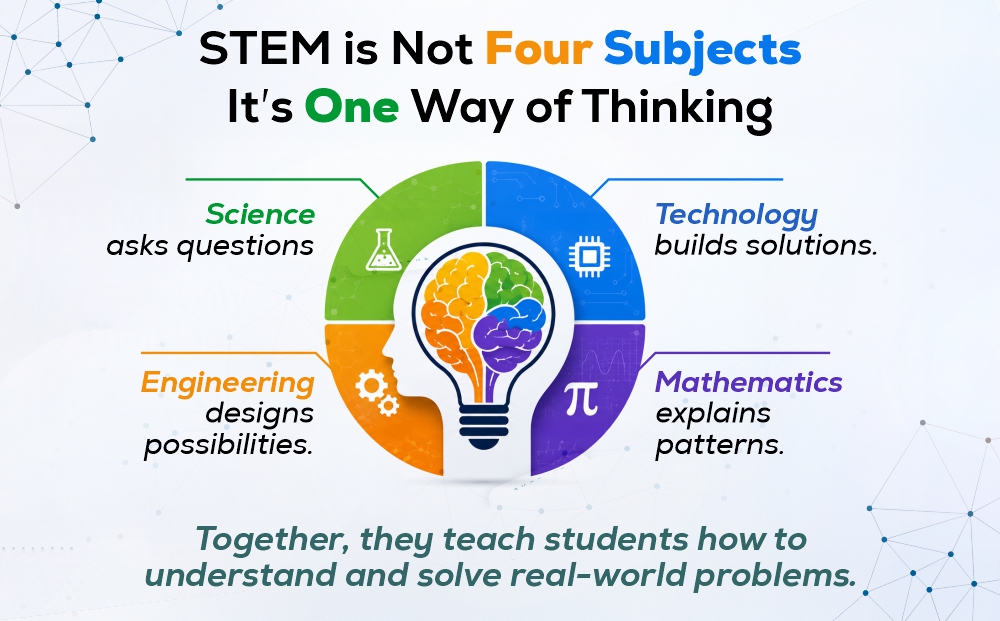
STEM in plants is the main supporting axis of the plant, and somewhere in education, too is the crux. It is an acronym for Science, Technology, Engineering, and Mathematics.
Though it was not a unified term from the start, as these were taught as separate disciplines and emerged in different times by different sources. Mathematics had Geometry by Euclid, Theorem by Pythagoras, zero and decimal systems by Indian Mathematicians. In science, Natural philosophy by Aristotle, Medicine by Galen, and the concept of engineering came from Roman architecture and Chinese inventions. In India, science had Charaka Samhita who introduced medicine, Charaka and Sushruta who together founded Ayurveda, and personalities like Jagdish Chandra Bose and C.V. Raman who developed modern science eventually.
With colonial rule and increase in the focus of administrative training and literature, the decline in traditional science became evident.
It was in 2021 that STEM education & Stem toys was introduced and it became a new concept in the Indian system.
The technical-vocational market is predicted to reach USD $116.5 million by 2030 with a growth rate of around 13.5% CAGR and 10.8% growth which is around 4x faster than non-STEM jobs.
That is the importance STEM Education is going to play in the future of a student's life.
How Olympiads strengthen Mathematical Thinking?
1. It has analytical question patterns so when students brainstorm on the questions and ways to solve them, somehow they test their logic and understanding, as they train their brain to think differently. So thinking on how to use the concepts, how to apply them in the questions, analysing the question to understand what situation is it talking about and accordingly reasoning with them makes them think deeper and learn better.
2. It helps develop their non-routine problem solving skills, where they are able to face complex and unfamiliar situations which do not have any clear or pre-defined formula or any step by step procedure. It requires a sense of creativity and originality to solve the problems in front. Because the questions students are expected to solve are tricky ones that do not just test whether a person remembers the formula but gives them real-life situations that makes them think on what all are the ways how the question can be solved.
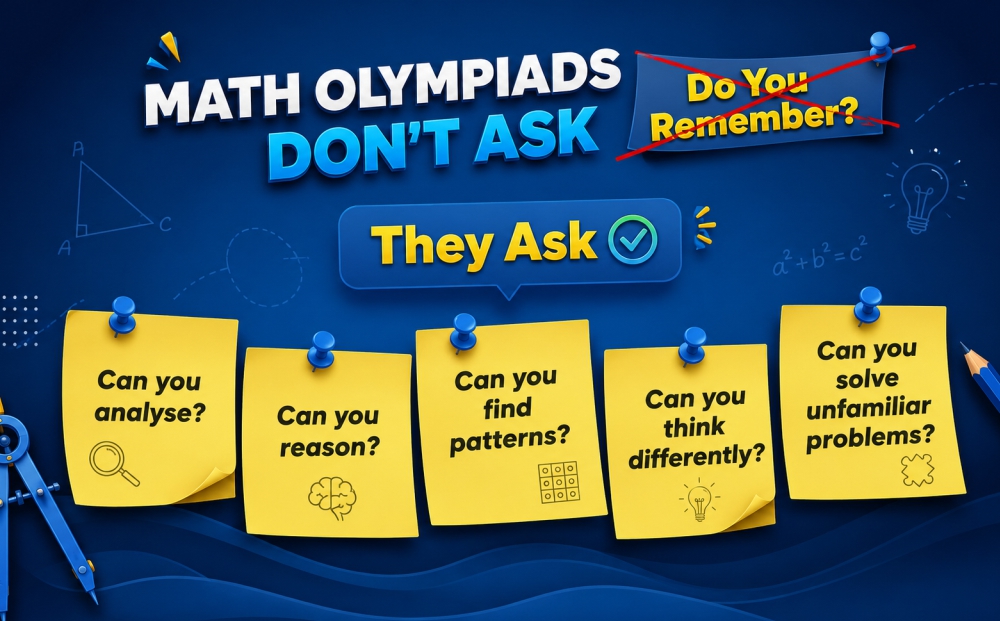
3. It helps them not get stuck in one problem altogether. Olympiad problems have more than one method of solution so when students attempt Olympiad questions and are not able to find the answer to it, they look for different ways to solve the same questions. This develops critical thinking in them as they learn new ways to think and set better patterns for themselves.
4. Overall, participating in Olympiad exams helps a student improve their ability to think analytically and understand deeper. It builds confidence in them that they will be able to solve real life problems. And seeing new and unfamiliar problems not only saves them from the fear of uncertainty but also helps them build adaptability and the ability to think independently.
How Olympiads Build Scientific Thinking?
1. It accomplishes hypothesis testing in students where students get to formulate theories about the natural phenomena, design tests, and in observing outcomes by brainstorming solution ideas from the question. This develops the ability in students to think through scientific concepts, become confident in their prediction by testing the cause-effect relationships. Maybe the future scientist's vision starts from the first Olympiad they sit for.
2. It makes them good in experimental design where students are able to plan fair tests where they decide what has to be changed, what has to be measured, and what should be the things that they keep the same. This helps them in learning how to do science experiments properly.
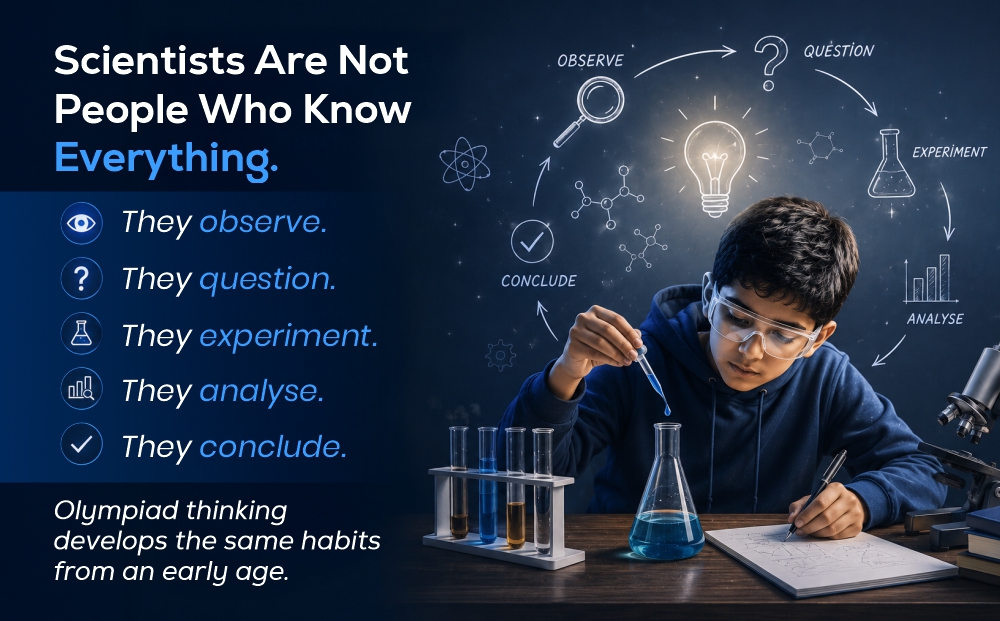
3. It helps them understand the cause-and-effect in natural systems as they get to think and question as to why things happen like why ice usually floats or why plants need sunlight or how food chains work. This helps them explore how nature works and get to understand deeper about the real reasons behind the everyday things.
4. It shapes their conceptual understanding rather than memorising facts blindly. They learn the details on WHY things happen like WHY plants need light. This helps them touch the basic aspects of science which they can use when the need comes instead of remembering the concepts when it comes to light.
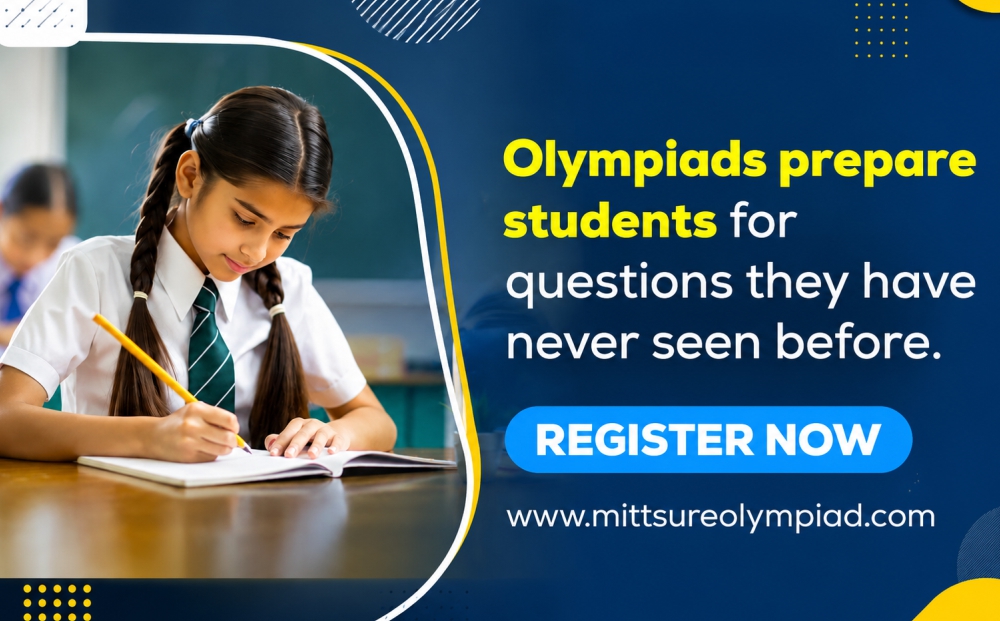
Building careers with STEM Education is not just about enhancing the skills of the subject Science, Technology, Engineering, and Mathematics. The future is heading in a direction where individuals need to have the ability to think beyond any dependency, solve problems creatively, keep learning continuously, work through the uncertainty, and adapt to the new technologies efficiently. So if students plan on pursuing a career in Artificial Intelligence, Data Science, Robotics, Medicine, Engineering, Space Science, Research, etc., they would still need strong STEM thinking abilities. And at Mittsure Olympiad Masters, we help students build these skills years before they would have to make their career decisions.
FAQs
1. How do Olympiads support STEM education?
When students participate in Olympiad exams, it strengthens their ability to draw valid conclusions, break down complex problems into smaller ones, and gives students a scientific perspective to analyse the world and all these are core components of STEM education.
2. Are Olympiads only useful for students interested in Science and Mathematics?
Olympiad exams do not just develop the subject skills in a student. It builds critical thinking, problem-solving, and reasoning skills that help them overall in sorting life situations.
3. At what age can students start building STEM skills through Olympiads?
Students can start as early as from Class 1 with Mittsure Olympiad Masters that provides them the right opportunity to develop STEM thinking gradually from an early age.
4. Can Olympiads help students prepare for future competitive exams?
Yes. The logical reasoning, analytical thinking, and application-based approach of Olympiads often aligns closely with many national-level competitive examinations.
Recent Posts



- Mittsure Olympiad
- Mittsure Olympiad


- Mittsure Olympiad

- Mittsure Olympiad


- Mittsure Olympaid

- Mittsure Olympiad

- Mittsure Olympiad




- Mittsure Olympiad