How Olympiads Expand a Child’s Thinking Skills at an Early Stage
Every parent wants their child to do more than score well in exams. We want children who ask “why?”, who stay curious when a problem gets tricky, and who can think their way through something new. The early years, when young minds are naturally curious and quick to absorb, are the best time to build these abilities. This is where Olympiads can make a real difference. Unlike regular school tests, which often reward memorisation, Olympiad exams are designed to make children think. They bring in logical reasoning, pattern recognition, and application-based questions that nudge young learners to look beyond the textbook and understand concepts in a deeper way.
Starting early means these skills grow with the child. Each question becomes a small exercise in focus, problem-solving, and confidence. Over time, children learn that a difficult question is not something to fear but a puzzle worth solving.
In this blog, we explore how Olympiads help shape a child’s thinking at an early stage, and why they can be one of the most rewarding learning experiences in the foundation years.
1. They Shift Learning from Memorising to Understanding
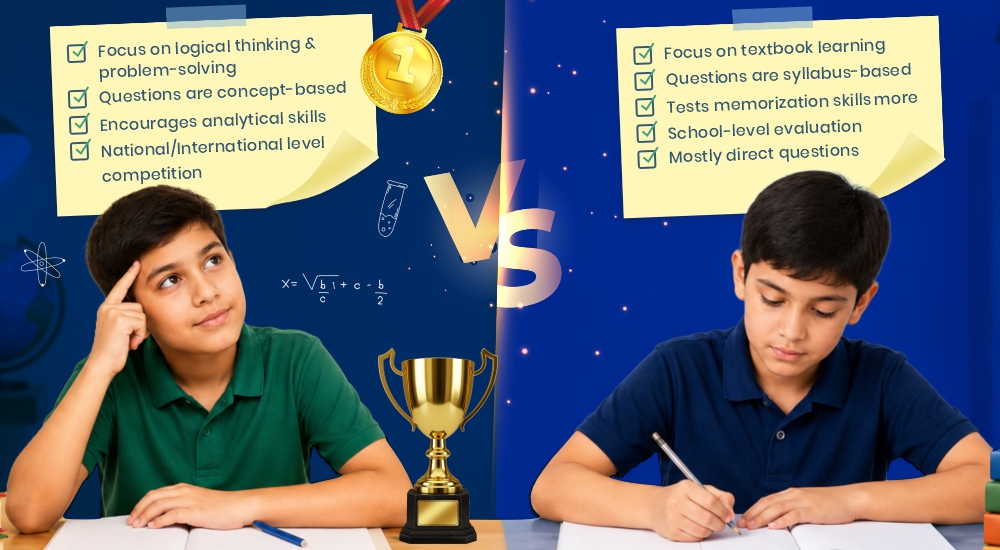
In a regular classroom test, a child can often succeed by remembering answers. Olympiad questions work differently. They present a situation and ask the child to figure it out using concepts they already know.
For example, instead of asking "What is 5 + 3?", an Olympiad question might show a pattern of numbers and ask what comes next, and why. To answer, the child has to observe, compare, and reason. Over time, this habit of understanding the "why" becomes second nature.
2. They Build Logical and Analytical Thinking
Many Olympiad questions involve patterns, sequences, puzzles, and reasoning. A young child learns to:
• Spot relationships between objects, numbers, or ideas
• Break a big problem into smaller steps
• Eliminate wrong options and arrive at the right one
• Check their own answer before moving on
These are the same skills used later in maths, science, coding, and everyday decision-making.
3. They Encourage Curiosity
Small children are naturally curious, and Olympiad-style questions feed that curiosity. When a question looks unfamiliar, it sparks a thought: "How can I solve this?" Instead of fearing the unknown, the child learns to explore it. This attitude, being comfortable with not knowing the answer immediately, is one of the most valuable thinking skills a child can have.
4. They Improve Concentration and Patience
Olympiad questions often need a few minutes of focused thought. In a world of short videos and quick answers, this practice trains children to stay with a problem. Gradually, their attention span improves, and so does their patience when work gets challenging.
5. They Strengthen Problem-Solving Confidence
When a child solves a tricky question on their own, the feeling of success is powerful. It teaches them that effort leads to results. Even when they get an answer wrong, the experience is useful. They learn to try again, think differently, and not give up. This builds resilience and a healthy attitude toward challenges.
6. They Develop Better Time Management
Olympiads are usually timed. Even at an early stage, children begin to understand how to read a question carefully, decide where to spend their time, and move ahead when stuck. These are simple but lasting habits that help in every exam they will ever take.
7. They Build a Strong Foundation Across Subjects
Olympiads are available in subjects like Maths, Science, English, Reasoning, and General Knowledge. A child who practises across these areas develops a well-rounded understanding. Concepts are connected to real life, which makes learning feel meaningful instead of heavy.
8. They Create Healthy Competition
Being part of an Olympiad shows children that there are many other bright learners out there. This encourages them to improve themselves, not to compare unkindly, but to aim higher. When handled with the right support from parents and teachers, this builds motivation and a growth mindset.
The Bottom Line
Olympiads are far more than competitive exams. At an early stage, they gently stretch a child’s mind beyond rote learning, encouraging curiosity, logical reasoning, and the confidence to tackle unfamiliar problems. When children learn to ask “why” and “how” instead of simply memorising answers, they build thinking habits that stay with them through school and life. The real value lies in the journey, not just the rank or medal. Every challenging question teaches patience, every mistake becomes a lesson, and every small success builds self-belief. Early exposure to this kind of structured, thoughtful problem-solving also strengthens focus, analytical ability, and a genuine love for learning.
For parents and teachers, the goal should be to make Olympiads a joyful experience rather than a pressure-filled one. When approached with encouragement and the right guidance, they can lay a strong foundation for academic growth and independent thinking, helping young learners become not just better students, but sharper, braver, and more curious thinkers.
Recent Posts



- Mittsure Olympiad

- Mittsure Olympiad

- Mittsure Olympiad
- Mittsure Olympiad

- Mittsure Olympaid
- Mittsure Olympiad

- Mittsure Olympiad




- Mittsure Olympiad